
What are OPMs?
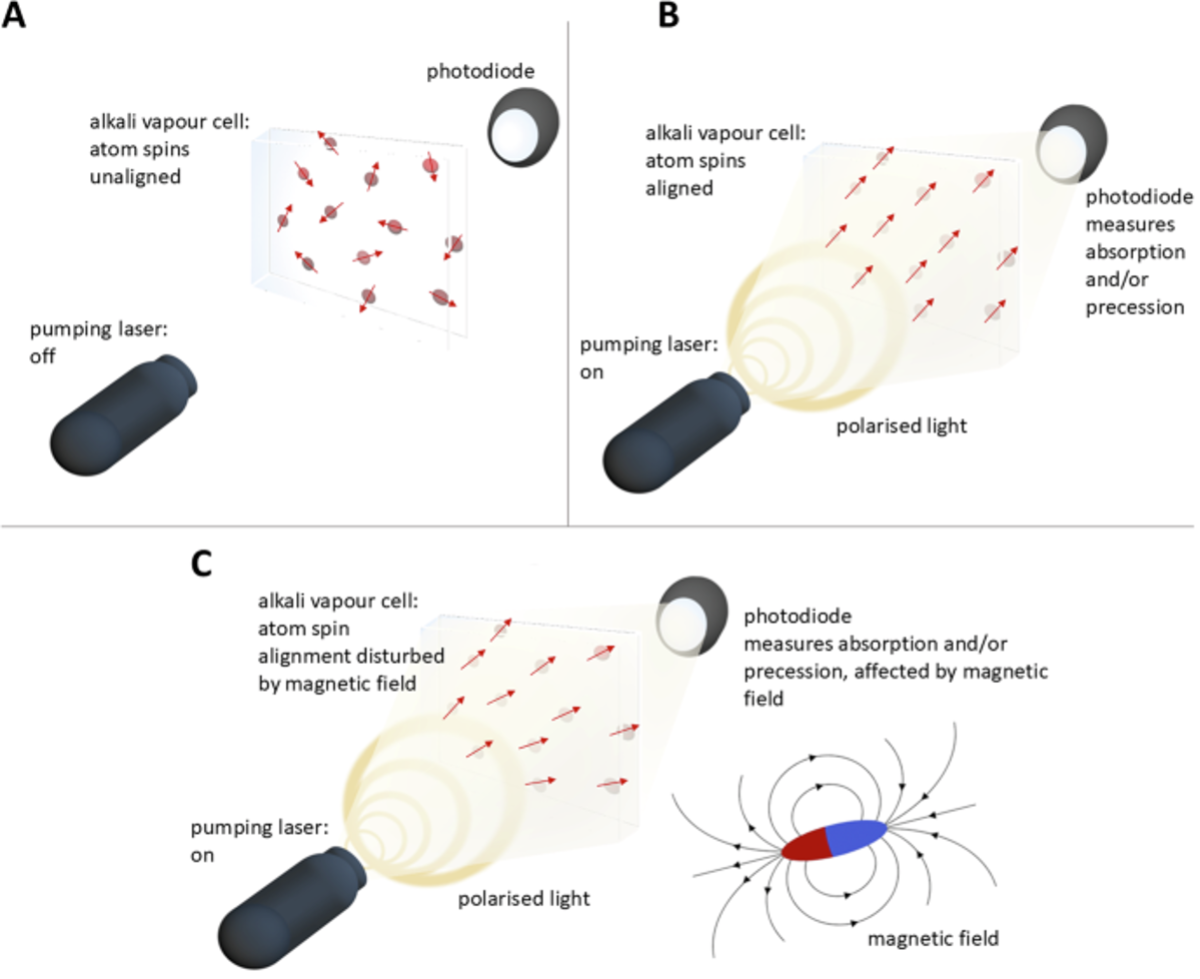
At the OMCB, we use optically pumped magnetometers (OPMs), advanced quantum sensors that measure magnetic fields using atomic vapors. Each sensor contains a small glass cell filled with alkali atoms (e.g., rubidium), which are “pumped” into a specific quantum state by a polarized laser beam, aligning their atomic spins.
When the extremely weak magnetic fields generated by neuronal activity pass through the sensor, they interact with these atoms and modulate the transmitted light. This change is detected by a photodiode, enabling highly precise measurement of brain activity, without the bulky cryogenic cooling required by older technologies such as SQUID-based MEG (superconducting quantum interference devices).
What is OPM-MEG?
OPM-MEG refers to the use of these sensors in a functional neuroimaging system that records the brain’s magnetic fields in real time. A key advantage of OPM-MEG is its improved signal-to-noise ratio (SNR) compared to conventional SQUID-MEG systems. In SQUID-MEG, sensors must be immersed in liquid helium within a vacuum-insulated dewar, creating a fixed distance of ~2 cm between the sensors and the scalp.
In contrast, OPMs operate at room temperature and can be placed just millimeters from the head. Due to the inverse square relationship of magnetic field strength with distance, this proximity results in substantially stronger signals, yielding cleaner and more sensitive data.
This enhanced signal quality also improves spatial resolution, allowing more accurate localization of neural activity. As a result, OPM-MEG is a powerful tool for identifying biomarkers and circuit-level dysfunctions in conditions such as epilepsy, movement disorders, psychiatric illnesses, and neurodevelopmental disorders.
Additionally, the flexible design of OPM sensor arrays allows helmets to be adapted to different head sizes, ensuring consistent and high-quality coverage across participants. By combining millisecond temporal resolution with improved spatial precision, OPM-MEG provides a sophisticated, non-invasive window into human brain function.
Want to know more?
Check out this paper in Translational Psychiatry
Brickwedde, M., Anders, P., Kühn, A. A., Lofredi, R., Holtkamp, M., Kaindl, A. M., Grent-‘t-Jong, T., Krüger, P., Sander, T., & Uhlhaas, P. J. (2024). Applications of OPM-MEG for translational neuroscience: A perspective. Translational Psychiatry, 14(1), 341. https://doi.org/10.1038/s41398-024-03047-y
Read this overview of OPM-MEG in Trends in Neurosciences
Brookes, M. J., Leggett, J., Rea, M., Hill, R. M., Holmes, N., Boto, E., & Bowtell, R. (2022). Magnetoencephalography with optically pumped magnetometers (OPM-MEG): The next generation of functional neuroimaging. Trends in Neurosciences, 45(8), 621–634. https://doi.org/10.1016/j.tins.2022.05.008